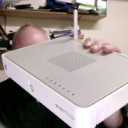
So just to clarify your last suggestion I would put the modem router in bridge mode
The trick is to get the modem/router to act as if it were only a simple modem. Some modem/routers can be set up to operate this way, and some cannot.
Even if a modem/router can be set up to act as a simple modem, some Internet Service Providers (ISPs) lock down the settings to prevent users from changing things around.
If you are considering this, it is always best to contact your ISP to find out whether this type of setup is even possible, and if it is, whether the ISP will help you with the setup and provide future support with this type of configuration.
Frankly, even if it the modem/router can be set up this way, the ISP will usually be less than thrilled about the idea. It means more work for them, and more troubleshooting if things do not work.
If your ISP offers a simple modem (it will have only one Ethernet port), swapping out the modem/router for a simple modem is by far the easiest thing to do.
When you have the modem/router set up as a simple modem, or have swapped the modem/router for a simple modem......then, the Router Mode of the AirPort can be changed from "Off (Bridge Mode)" to DHCP and NAT.
Back to My Mac usually works well....or has a better chance of working well.....when the "main" router is an Apple device that is set up as the "main" network router handling DHCP and NAT functions.
The NAT and upnp would then be switched off on the modem router?
All routing functions....DHCP and NAT, UPnP, wireless, etc are automatically disabled when a modem/router is set up to act only as a simple modem, assuming that it can be set up this way.
If I go for that solution do I still have to worry about opening ports etc?
No, if you are planning on using Back to My Mac. Yes, if you use a different method for remote access, which is known as Port Mapping or Port Forwarding. Unfortunately, this is not easy for most users to implement, even with step by step instructions, so the assistance of an IT professional is often needed to set things up.
In addition, to set up Port Mapping, you will need what is known as a Static IP address from your ISP, which usually means a business level account at significantly higher cost.