What are the recommended iMac specifications for a 5-year lifespan?

I am looking to upgrade my imac I bought in 2018 and want to get specs where I won't have to upgrade for 5 years. What specs should I get?


[Re-Titled by Moderator]

Original Title: iMac specifiactions

iMac (2017 – 2020)

Posted on Dec 27, 2025 6:39 AM

Reply
17 replies

Dec 27, 2025 8:23 AM in response to ChrisCS13

In addition to RAM and HDD capacities already mentioned …


… it can’t hurt to get the newest “M” processor you can afford.


This method will help keep you “current” with MacOS “upgrades” as long as possible AND still allow you to continue to productively operate even after your hardware is no longer receiving the “latest and greatest” OS “upgrades.”


Many Mac users who went “high end” at initial purchase are still productively computing on hardware now only capable of running Ventura or even older OSs.

Dec 27, 2025 8:38 AM in response to lkrupp

lkrupp wrote:

As much RAM as you can afford. As much storage as you can afford. That’s about it. Software requirements continue to grow, app size and data size continue to grow. Hardware has to keep up with software, not the other way around.


With the 24" iMacs, I would also recommend getting one of the models that has four USB4 / Thunderbolt ports.


The entry-level model has only two of those ports – and there's nowhere else to plug in USB peripherals, so you will find yourself needing a hub or dock very quickly.

Dec 27, 2025 8:55 AM in response to Chattanoogan

Chattanoogan wrote:

In addition to RAM and HDD capacities already mentioned …

… it can’t hurt to get the newest “M” processor you can afford.


There are two aspects.

  • Generation: M1, M2, M3, M4, M5. M5 is the latest, but currently only available on entry-level 14" MBPs – and on iPad Pros (which don't run macOS).
  • Processor level: Plain, Pro, Max, or Ultra. As you go up to higher levels, you get more GPU cores, more/faster CPU cores, the ability to order more RAM, etc. Within a level, there may sometimes be variants (e.g., you can get the 24" M4 iMac with either 8 or 10 GPU cores).


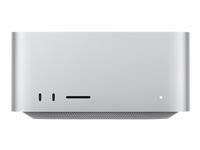
The 24" M4 iMac uses plain M4 processors. If the OP wanted a stronger GPU, the OP could get the Mac mini in versions that have M4 Pro chips, or the Mac Studio in versions that have M4 Max chips.


For everyday use (i.e., not high-end gaming, or intensive photo processing or video workloads), even the GPU in the plain M4 chip is likely to be strong enough.

Dec 27, 2025 9:15 AM in response to ChrisCS13

Get at least the recommended specs for your important (heavier) apps, and get no less than a middling model Mac with more memory and more storage than your current usage trends.


Given your current hardware, likely options are Mac mini M4 with your own peripherals and your own 4K or 5K display, or an iMac with the one-size fits all 24” display, whatever Mac with 16 to 24 GB memory minimally, and, again, whatever fits with your current memory and storage trends.


Also check how many USB-A, USB-C, HDMI, 3.5mm audio, and/or Thunderbolt ports are needed both now, and your trend.


You’ll probably want a hard disk of two to three times the size of your internal storage for Time Machine backups, or a NAS with Time Machine server support if you have the budget and the usage requirements for that. Or you can repurpose the existing iMac as a NAS, with sufficient external storage added.


One other detail: M-class processors and Apple main storage are stupidly fast. Picking a top-spec iMac 2020 i9 ten-core, Geekbench has 1644 single-core and 8800 multi-core, while the iMac 2024 M4 low-spec 8-core is 3749 and 14076. Very nearly double the performance, and in ~four years.


MacRumours has a guide to the Apple product release cycles here: https://buyersguide.macrumors.com/#mac


PS: I am amused by the “as you can afford” recommendations here though, as that might well sell some few folks here on a fully loaded Mac Pro, and a low-spec mini for the rest of us, dear reader. And Apple has as many salable variations available as different buyers have available cash. 😉

Dec 27, 2025 10:56 AM in response to ChrisCS13

I recommend getting a Mac Mini M4 with a 3rd party monitor. I have the following: a 10 Core Mac Mini M4 with 16 GB RAM and 1 TB SSD ($1084) with a 32" LG 4k monitor ($331) from Amazon.com)  is $1415 which is $541 less than a similarly configured new 24" iMac ($1956)  re 07/2025. Keep your keyboard and mouse from your current Mac for use with the Mini.  It leaves my previous i7 2017 17" iMac in its dust.


I got the above Mini with a 32" LG 4K monitor w/speakers for only $60 more than the 27" (didn't know the Mini had a speaker).  There are many monitors available in the 27" size for $100 on up to $500 depending on what features you want.  The monitor prices are before tariffs.


Dec 27, 2025 1:00 PM in response to dialabrain

dialabrain wrote:

I would mention a 24" iMac has a 4.5K resolution screen, which means, it will look sharper than any 4K monitor regardless of size or price. You would need a 5K or better monitor to look as good. Of course if you have poor eyesight that may not matter.


A good 24" 4K monitor would come close to the 24" iMac's screen, but I only know of two currently, or recently, on the market.

  • LG – LG 24UD58-B. This one has an attractive price ($300), and connects via DisplayPort or HDMI. It has an IPS screen (which is good). But there is no mention of sRGB coverage, and when monitor vendors other than Apple omit that specification, it often means that basic color accuracy is bad. In accessing the LG site now, I also see a new(?) label saying "DISCONTINUED".
  • Asus – ASUS ProArt Display PA24US Professional Monitor. This is a very high-end monitor that costs $1300, and is clearly aimed at professional photographers and videographers. It has good coverage of Adobe RGB & DCI-P3, and a "built-in motorized colorimeter" to do hardware calibration. Still, if your budget was this high – and you weren't a professional – putting that $1300 towards a 27" 5K monitor without the calibration bells and whistles would probably look more attractive.


With 27" 5K (5120x2880 pixel) monitors, the choices used to be Apple's $1600+ Studio Display, and a LG. Now there are a few more 27" 5K monitors (from Samsung, BenQ, Asus, and ViewSonic), but I'm guessing that all are going to be on the expensive side relative to 27" 4K ones.


At the 32" size, you're looking at 6K resolution and something like Apple's Pro Display XDR ("if you have to ask how much it costs, you can't afford it.").

Dec 27, 2025 4:29 PM in response to ChrisCS13

You have gotten a lot of configuration advice and I see from your last post that you chose a well-configured model. You can certainly expect more than 5 years lifespan out of it.


I just want to add that no Mac has ever failed me (I've owned & managed lots of them over the years). Although a few of my own Macs have maxed out their macOS compatibility ... two of them are over 15 years old and are still running strong

Dec 29, 2025 11:27 AM in response to ChrisCS13

I'm not sure what is meant by "specifications"

is that referring to current security updates, fully functioning web browsers, app compatibility, disk IO, GPU/CPU processing power?


not sure how to address without knowing the OP's focus, but


Macs function successfully with a very high HARDWARE percentage at five, ten, even fifteen years -- I see a shift in hardware percentages dropping in the immediate future with the maturing of Apples' soldered-in SSD, GPU, RAM because you can't repair them -- in the 2019 and earlier Macs you could replace the HDD/SSD, RAM -- now in 2026 you can't


WEAK LINKS in the M series silicon iMacs for their iMac screen issues, small integrated SSDs that get overworked and worn out (when the SSD, RAM, GPU fail, the machine cannot be repaired at any reasonable price) -- so what do you do with a machine that cannot be repaired (is the $2,000 question here)


the issues that destroy good working Apple 'vintage' Macs (2017 and earlier, for the purpose of making my point) are their macOSes have been dead-ended in big tech's "end of life" cycle to keep computer security healthy and cutting edge


Micro$oft is in the same boat with Windows 11 and 2019 hardware that doesn't support the newer security protocols -- Apple's 'vintage' machines no longer receive security, browser updates that can open them to hackers -- their web browsers no longer function properly (many no longer work at all)


my point here is -- stick to production model years, macOSes that will be supported for the time period you need them -- call it PLANNED OBSOLESCENCE or PROGRESS ...


This thread has been closed by the system or the community team. You may vote for any posts you find helpful, or search the Community for additional answers.

What are the recommended iMac specifications for a 5-year lifespan?

Welcome to Apple Support Community
A forum where Apple customers help each other with their products. Get started with your Apple Account.