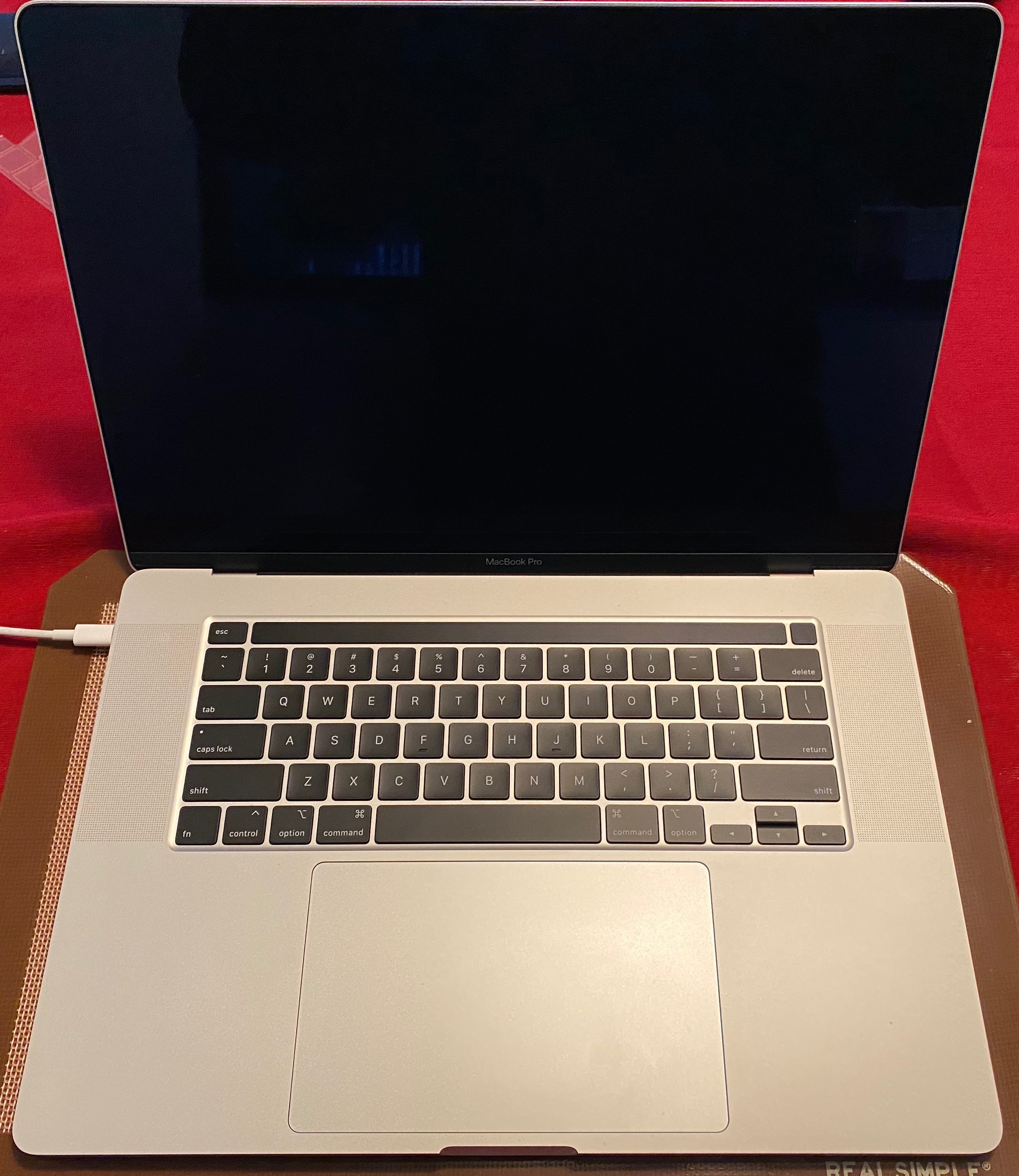
MacBook 16-inch Fan Noise

We are testing two new 16-inch MacBook's before doing a rollout across our organization. Under low loads (25% cpu utilization), fan noise will get annoyingly loud. We're not doing any GPU related and more routine work such as: using web applications, debugging web pages, Microsoft Teams conferencing (audio/video) with a handful of people, Photos downloading from iCloud, Mac Mail downloading a new mailbox from Exchange.


We DID NOT notice this on our 2015 MacBooks and this might prevent us from continuing the 16-inch MacBook rollout in our organization.


Interested to hear others experiences.


Tim

MacBook Pro 16", macOS 10.15

Posted on Nov 21, 2019 11:34 AM

Reply
Question marked as Top-ranking reply

Posted on Jan 10, 2020 7:08 AM

RESOLVED: For those of you using a second monitor.


My 16 was plugged into the Usb c HDMI cable, AND plugged into the Macbook charging cable, thus "double charging" my laptop which would cause the fans to ramp up and my computer would over heat. As soon as I removed the Macbook charger the fans returned to normal. I didn't realize the newer Usb C HDMI cables would also charge the device from my computer monitor.


Hope this helps!

4,224 replies

Jan 16, 2020 9:45 AM in response to TimUzzanti

We got "sort of" an update from the Apple Business Team: They can't get any information about the cases that have been opened by Apple Engineers from these community topics, but they're continuing to ask to try and get us some kind of an update. They did say that what seems to be happening is very similar to what happened with the 15-inch MacBooks and the introduction of both i9 and i7 processors. Much of what was occurring was related to the GPU and the high CPUs were pushing the MBPs beyond its thermal limits. Apple has an EFFA (Early Field Failure Analysis) process which can take up to 180 days. In that timeframe they take the piece of hardware, send it to the engineers, who then evaluate the issues and attempt to solve the problems. I think the consensus is, there is a problem with the 16-inch MBPs, so you have leverage with extended return periods.


We have new employees and need new hardware ASAP. We requested an extended return policy so that we can move forward beyond this testing phase with a few 16-inch MBPs. However, we will be using eGPUs with most of these new purchases until Apple fixes the hardware issues. Not everyone has this luxury and this is only a temporary solution for us.


We've done some additional work doing actual tests with Xcode and Adobe products and have been able to get the CPUs and COREs to 100 degrees Celsius for extended periods. That is no bueno for the hardware. Even at full fan speeds, they can't keep up with the heat load with external monitors.


Because we have a number of eGPUs, we are now using one with every MacBook to eliminate the heat. We have able to reduce the heat by 50% and the 16-inch MBPs will stay within good working conditions. Shutting the lid with the eGPUs will essentially disable the internal Radeon Pro and is necessary to reduce overall heat conditions.


There is no question there is an issue and it seems to be with ALL configurations. The lower Radeon Pros will produce slightly less heat, lower CPUs will produce slightly less heat, but adding one or two monitors, and even USB-C hubs, will add to heat conditions. As many of you have noticed, the power draws on these laptops are excessive because of the power demands related to the GPU etc.


To summarize, although the GPU is the biggest culprit, everything else adds to the problem. This topic has been referenced from a number of other discussions in MacRumors. If there is some peace of mind, it's clear they're seeing the issue and it's a big problem. This is something Apple will need to fix or resolve even beyond standard warranty periods because the 16-inch MBPs are not working properly since their release.


Thanks, 


Tim


[Personal Information Edited by Moderator]

Jan 25, 2020 10:17 AM in response to fmorga

Again, I think my MacBook is not nor was defective. The issue was in software I used (Node.js with external package which used 240% of CPU which made the fans go crazy). After I found solutions how to fix it I had another problem (again with node.js and it's node_modules folder), which made Spotlight indexes those files, which is useless, so I removed it from indexing and the macbook went quit. These are the fans with normal use without external monitor connected.

When I connect the external monitor fans are spinning around 2500rpm while VS code, Visual Studio and other software is in use. It gets more loud when I compile Xcode project, but only just for a few seconds.


So again, you who has problems, try to look at the activity monitor and try to find apps which are using a lot of CPU for no reason and try to fix the problem if you can.

Feb 1, 2020 4:16 PM in response to Grant Bennet-Alder

Actually, there is a way to throttle the cpu on every Mac. You can use Volta app where you can set power limit manually. I’ve been using it on my every MacBook Pro (2016, 2018, 16”2019)


But this is not the case here. The issue here is that there is some sort of unjustified high power draw when both internal and (probably) any external display are used at the same time (long story short).

On 2016 and 2018 model connecting an external monitor results in 5W increased power draw of the entire machine. But on the 16” it’s 20W. Tested on exactly the same external monitor, resolution and refresh rate. It’s huge waste of power on nothing, just generating more heat.

Mar 13, 2020 9:33 AM in response to TimUzzanti

It's all about resolution of external monitor. I did some testing on my own 16".

1) If I run it with internal display only I get ~20w total power usage

2) Running it with internal + 1920x1280 = ~50w (20 for gpu)

3) Running it with just external 1920x1280 = ~50w (no drop)

4) Running it with external scaled down to 1920x1080 = ~30w (5w for the gpu)

5) Running a 3d game (world of tanks blitz for the reference) + only external display running 1920x1080 ~= 35w (7w for the gpu).


So basically idling on anything above fullhd (1920x1080) results in 3-4 times bigger power consumption than running a 3rd game on full hd. This is so annoying.

Mar 17, 2020 7:34 AM in response to Futurama

100% agree! Chrome is the worse resource hog and not only does it activate the dGPU but it causes Macs to heat up and drain battery. Same happens on Windows machines. People complain on Reddit about fast battery drain and heat and Chrome is usually their culprit. If Chrome's extensions are much more important to people over battery life and a cool running computer then some people's priorities are certainly in an odd place. I would use Chrome for very select things if necessary, otherwise Safari and other alternative browsers run far better.

Apr 6, 2020 6:29 PM in response to SF6

You are totally right. I don't have HWinfo so I can't see the clock rate of the GPU. I'm relying on GPU wattage (SMC key PG0R) to determine the power profile of the GPU.


I changed the resolution of my two external monitors and found:

2 external monitors both @ 1080p 60Hz,: GPU runs at 5W (same resolution & freq.)

1 @ 1080p 60Hz, 1 @ 1080p 50Hz: GPU runs at 19W (same resolution, different freq.)

1 @ 1080p 60Hz, 1 @ 1024x768 60Hz: GPU runs at 5W (different resolution, same freq.)

Built in monitor @ 1792x1200 60Hz, 1 external @ 1080p 60Hz 19W (different resolution, same freq.)

Built in monitor @ 720x450 60Hz, 1 external @ 1080p 60Hz 19W (different resolution, same freq.)


It seems there are some "magic" combinations of resolutions & freq. allowing the GPU to runs at a lower power profile. And as long as there are 3 monitors, regardless what the combination is, GPU will run at full power. This sounds really like an AMD driver/firmware issue. nVidia had similar issues and they were able to fix it.

Apr 6, 2020 6:56 PM in response to pancakes-addiction

I just ran a quick test (have work to get to so not thorough), but can confirm in clamshell mode with two extgernal monitors GPU Z records the memory clock pegged at 1472mhz running on native resolutions, setting both monitors to a 16:9 aspect ratio fixes the issue, the memory clock drops to below 200mhz and the fans become silent.


[Edited by Moderator]

Apr 7, 2020 8:39 AM in response to ahmedfromreservoir

ahmedfromreservoir--


is the external display using DisplayPort/ThunderBolt/USB-C or a "legacy" interface such as HDMI?


My prediction would be that HDMI on the external display would cause hi wattage and hi temps with HDMI when built-in was also active, and Displayport on external display would allow low temp and low fans when built-in display was active.

Apr 8, 2020 12:41 PM in response to raimiss

The built-in display does not have its own screen buffer, so it will be seen as a "legacy" display requiring the "heartbeat" refresh -- the entire screen data, every 60th second, without fail or the screen will be partially blanked and the user will see it as flashing.


The code segment referenced on a GitHub page above show logic that checks for display TYPE, and if more than one display is a "legacy" display (and therefore require heartbeat refresh) the memory speed and power will be increased to be certain there is no loss of data with two or more displays requiring a heartbeat refresh, and very tight time constraints.


This appears to be what causes the power to be set to a higher level, and also explains why when the built-in display (by definition a legacy display) is turned off by closed clamshell mode, the remaining display(s) may use less GPU power if at least one of them is a directly-connected DisplayPort (or ThunderBolt, or USB-C) display that does NOT require the "heartbeat" refresh.


I think the problem with using a Dock is that the Dock may request DisplayPort Dual Mode, to ensure its data stream includes the heartbeat refresh, in case it has to support a Legacy display.


Executive summary: you can get the GPU power and fan noise lower if no more than one of your displays is a legacy display {HDMI, DVI, VGA}.

(the built-in display is a legacy display)

(most Docks will count as a legacy display regardless of how the actual display is attached)


Apr 12, 2020 7:13 AM in response to igors192

It appears that when you attach more than ONE "legacy" display, the timing requirements to support the "heartbeat" refresh and still keep the screen from blanking are so high that the card shifts RAM to fast, high power mode.


The "heartbeat" refresh was used to maintain the data for CRT displays that did not have a Screen Buffer. The entire screen data must be fetched and sent to the display under strict timing requirements every refresh period (like 60th second). Otherwise, a portion of the screen will be blank for that period, and will be seen to be flashing.


"Legacy" displays are {HDMI, DVI, Analog VGA, and possibly ANY interface on some Docks} Also, the built-in display counts as a "legacy" display, so if you do not using closed clamshell, the built-in is your ONE allowed "legacy"display.


The rest of your directly-connected displays {DisplayPort family, ThunderBolt, USB-C} cause far less timing-sensitive load on display RAM, so the card often continues to run in low power RAM mode. (We do not het have enough data to answer definitely when low power RAM mode is precluded for other reasons.)

May 2, 2020 9:21 AM in response to DPJ

In my case the temperature goes up by 20 degrees just by connecting the external monitor but it starts getting really hot after 10/15 minutes (without doing nothing, not even browsing the web) and at that point the fans will start going crazy, sometimes all the way up to 5000 RPM with 0 apps or software running and CPU and GPU usage at less than 1%.

I know exactly 18 people that got a MacBook Pro 16-inch (from my office and friends, not here on this forum) and all of them are having the same issue, some of them had their machine replaced 3 times and they are still experiencing the same issue, 2 of them gave up and finally got a full refund.

In my particular case I was able to "partially fix" the problem by changing the refresh rate to 144 Hertz, so now I can use the computer for daily tasks and the machine is always at 40/50 degrees and the fans are at 1835 (left side) and 1700 RPM (right side).

I can make a conference call with zoom and I can watch a YouTube video without any problem.

There are still some issues there but I can live with them until a fix is available (Power Nap off, kernel panics, just to name a few).

My biggest concern is that the USB-C port where I got my external monitor connected since day 1, is gone (I don't know if it's related to the high wattage issue or not), so at some point I will have to take the machine to an Apple store for repair, but unfortunately right now I'm working at one of my offices in South America and I don't want to take the machine to an authorized dealer here, I will have to wait until probably next here to take it to an Apple Store in the US.

I keep thinking that this is a software/driver issue because I have tested all previous versions of Catalina (and the future version as well) and you can see that in every update they change the wattage consumption, so far 10.15.4 is the best one when using the 144 Hertz refresh rate. The machine will only use more than 6 watts when it really needs it, for example watching a YouTube video will use 9/10 watts, in other versions is always 20 watts or more. And when using 60 Hertz refresh rate is always running at 20 watts or more, even when the machine has 0 apps or software running.

May 4, 2020 1:00 AM in response to TimUzzanti

After reading through this thread and having the same issues as described in many many post here.

For me the only solution is at the moment:

  • De-Activate Turboboost
  • Use a laptop stand for the MBP 16


Especially the laptop stand was a great invest.

Without that stand my MBP reached around 3.500 rpm when using a Windows VM (office work). Since I used the stand the average is 2.500 rpm.

The stand just lifts the MBP for 15cm in the back, but the airflow seems so much better that I now can work with a nearly quiet Macbook.


This thread has been closed by the system or the community team. You may vote for any posts you find helpful, or search the Community for additional answers.

MacBook 16-inch Fan Noise

Welcome to Apple Support Community
A forum where Apple customers help each other with their products. Get started with your Apple Account.