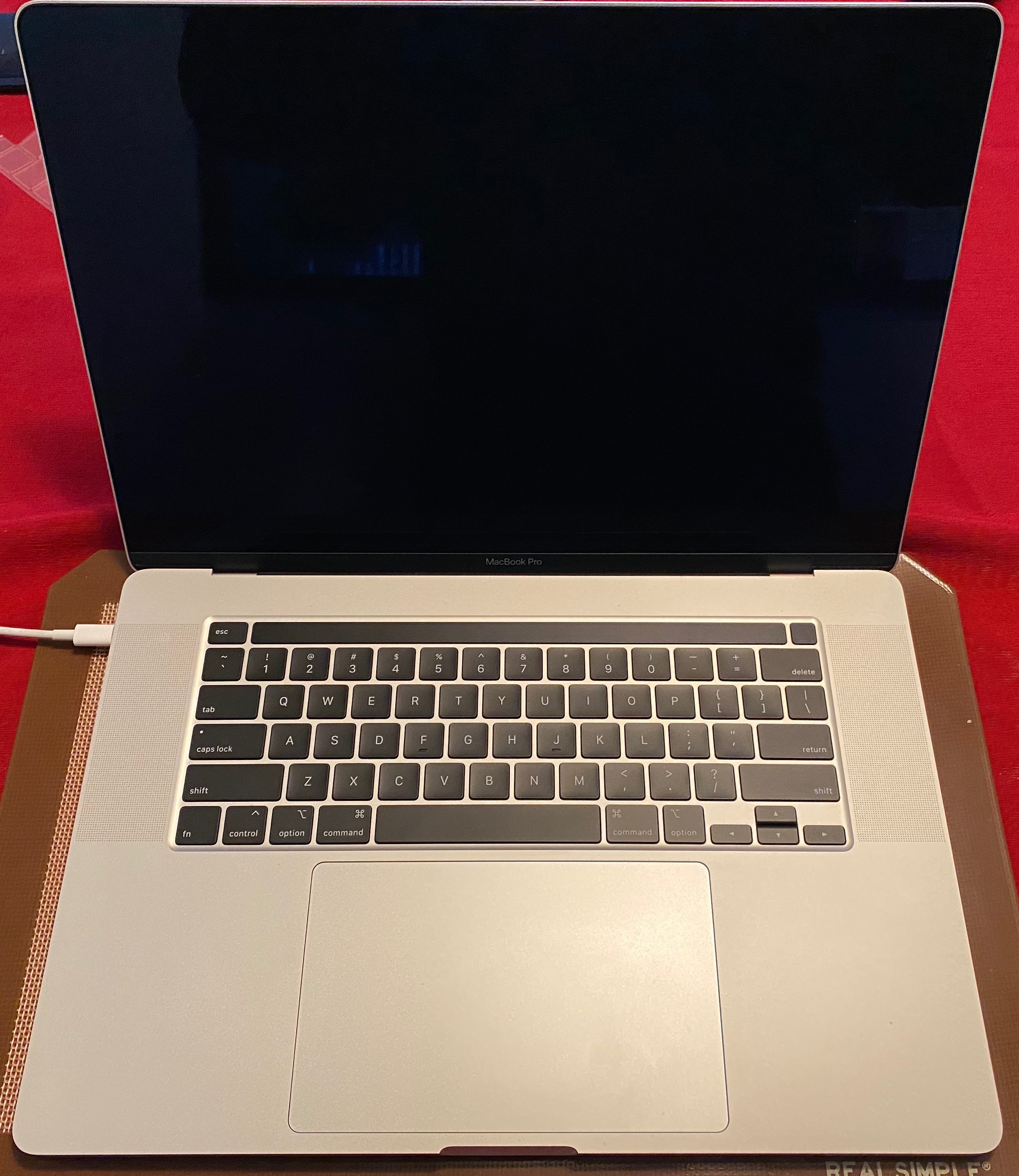
MacBook Pro 16 2019 10.15.4 WiFi Issues / Dropping Connection -- Help!

When I purchased this MacBook Pro, right out of the box I was experiencing dropped WiFi connections. Now I thought this was a simple bug and could be fixed by restarting/resetting SMC or PRAM reset, however, that wasn't the case. I'm still experiencing dropped WiFi connections even after doing those resets AND updating to 10.15.4.


Not sure why this keeps happening. Am I the only one?

MacBook Pro 16", macOS 10.15

Posted on Mar 28, 2020 1:57 PM

Reply
Question marked as Top-ranking reply

Posted on Jul 1, 2020 5:43 PM

Maybe your new MacBook Pro is generating some amazing USB 3 interfrence from its peripherals:


Why do I have difficulty with Wi-Fi or Bluetooth devices when USB 3 devices are attached to my computer?

Some USB 3 devices can generate radio frequency interference that can cause Wi-Fi and Bluetooth devices operating in the 2.4GHz band to have issues communicating with your computer. Here are some tips to avoid this issue:

• If your USB device has a cable long enough that you can move the device, place it away from your Mac—and make sure not to place it behind your Mac, or near the hinge of its display. The antennas for Wi-Fi and Bluetooth are located there, and USB 3 devices placed there might interfere with your wireless connections.

• If you're using adapters or dongles on a Mac computer with Thunderbolt 3 (USB-C) ports, plug them into the front port on the left side of your Mac, or into the ports on the right side (if your computer has them). These ports are the farthest away from the antennas, making interference less likely.

• To avoid interference on the 2.4GHz band using Wi-Fi, try using the 5GHz band instead. You can change this on your wireless base station. Bluetooth always uses 2.4GHz, so this alternative isn't available for Bluetooth.


--from an older Apple article, now retired.


Similar questions

143 replies

Jun 12, 2020 12:49 PM in response to jean-louis256

First, go to your iPhone and Turn off:


Settings > Personal Hotspot ...


... this setting ON creates an additional Router (in your phone) that competes with everything else around you.


--------

You are using 802.11ac, on channel 100 provided by your main Router. Your signal is very strong, and signal-to-noise is excellent.

You are using three antennas in an 80MHz band to achieve 1,300M bits /sec transmit rate, truly excellent. This is the best speed that can be obtained by your computer.


If this rate continues, there is no reason you should be having ANY difficulties with your Wi-Fi.


If this Transmit Rate diminishes, it is likely due to interference from other devices around you. I can see there are other phone devices and Printers acting as AirPrint printers that could be interfering. That interference would be shown as a diminishing Transmit Rate over time, and if it gets poor enough, by a disconnect.


If you are doing a major updating with Dropbox or similar service, or iCloud Photos, your speed test could proceed more slowly until the update is complete.


If any of the listed Routers are YOUR Routers, you can combine all into one Network by giving them the same network-name and the same password. Then they would stop competing and instead co-operate.

Jun 16, 2020 9:41 PM in response to jean-louis256

Hi everybody,

I did other tests, opened an Apple ticket, reinstalled everything and finally I think that the 2019 MBP is more sensitive to noise than the 2017 MBP.

If the signal is correct, the performances are the same.

MBP's 5GHz wifi works well if the access point uses undisturbed channels. If you have access to the Wi-Fi AP configuration choose free channels or restart it for auto config from time to time. Now I'm going to bring out my ethernet cables

Aug 8, 2020 12:16 PM in response to steve4321abcd

steve4321abcd wrote:

Thanks @grant I really appreciate the factual and technical advice.

I had many layers of aluminium foil wrapped around a USB-C cord with my 13 Inch, my understanding is that was a fault with inadequate insulation on the MacBook, not an issue with the cord?


It is usually badly-made USB-C adapters that are the culprit, not the cables themselves. There are reports of adapters that were so bad that, if placed near your Wi-Fi Router, could knock the 2.4GHz off the air.


Nov 6, 2020 8:30 AM in response to iTimC21

I'm also having this issue with 16" MBP 2019 running 10.15.7 that I bought one month ago (8 core i9, 64 gb ram). I migrated from a time machine backup updated to the most recent Os on a mid 2013 MBP and immediately had issues maintaining connection to wifi. From suggestions in this thread, I reinstalled macOs, reset SMC/NRAM and ran diagnostic reports to no avail and just installed the 10.15.7 supplemental update. I took it into the apple store last week and the genius ran hardware tests with inconclusive results. He reinstalled the network config files as an attempted solution but offered to accept the exchange of the MBP if this did not solve the issue.


Since reinstalling the network config files, the only improvement is that I can now consistently reconnect to the wifi after it has dropped whereas before it would consistently ask for the password and not be able to connect. Interestingly, when I'm in the same room as the router, I have no problem maintaining connection. When I go into a room about 10-15 feet away from the router, the connection drops more (also have noticed some correlation with drops when someone walks between the signal path). Also for reference, my partner has a MBP 2015 and a MBP 2017 (work computer) and she does not experience any wifi connections issues anywhere in our residence. My old MBP 2013 didn't have these connection issues either.

Nov 8, 2020 7:11 AM in response to Outback1966

Now you are showing that you have connected on channel 100, where fewer of your neighbors are likely competing. As expected for higher frequency operation, you have slightly less signal at -60, and noise at -94 still leaves Good signal-to-noise of 34.


The transmit rate shown does not agree with the modulation technique reported, so you may have caught is as it was changing.


To attain a transmit speed of transmit speed of 1,053 M bits/sec, you must are using three streams (essentially three antennas) and modulation technique that sends 256 patterns per signaling interval.


One "trick" that has benefited some users in busy neighborhoods is to set "automatic" channel selection in the Router. Then when the Router wakes up, it will select the least busy channel. It is not an accident that debugging procedures ALL start with "Cycle the power to your Router", as this will allow your Router to re-evaluate the current traffic at that moment and again choose the least-busy channel (at that moment).


An advantage that some newer Routers offer is that they are physically bigger. That allows the antennas to be physically farther apart, and can improve performance .


May 19, 2020 8:33 AM in response to dan8080

"I hope Apple get this resolved."


I've had two 16" MBP's and neither have had any wifi issues. As I mentioned to the other member you should test your Macbook's wifi outside of your home in a public wifi setting. You may be experiencing interference in your home. This is not a widespread issue and hardly anyone is talking about it here so to expect Apple to fix an issue that hardly anyone is talking about is being over-optimistic.

Jun 12, 2020 11:27 AM in response to jean-louis256

To analyze what is happening at the moment, hold down the option key and click on the Wi-fi icon on the menubar. you get a snapshot like this older one:


WHAT TO DO: transcribe or screenshot the parameters you see there ...

and also report: ¿How many networks do you see?

Readers will respond with an analysis of your local Network Neighborhood.


Oct 6, 2020 1:57 PM in response to iTimC21

Here's my latest findings. I got a new 16" MacBook i9 out of a different shop as Costco didn't have any in stock. I restored from my backup on the old MacBook and still had the same issues with the watch. This is where it gets a bit weird. I was still getting 500+/-50 MBs then I put bootcamp on so it purged some space and after the speed dropped considerably. Windows was still getting the speed but Catalina wasn't, it was dramatically slower - I thought it might be cloud traffic but nothing much seems to be moving.


I then upgraded to Big Sur out of frustration and it got even worse, speeds down to 2-3 MBs.


My next step was to try a different approach, I've reset everything and I'm still getting good speeds on the iPhone XS Max so it's not my setup. I have a multiband router mesh, 3 discs in a daisy chain all transmitting 2.4 and 5GHz - my SONOS 3 and harmony hub use 2.4 for example.


These all go via my previous router because each disc only has 1 port so the first disc plugs into a triple-band Asus hub along with some other heard wired devices. The Asus hub has wifi turned off on all 3 bands, (there's 2 different 5GHz options).


I enabled the 5GHz bands only on the Asus and I can now get 2-400 MBs on that but still maximum of 40 or so on the blended router so it looks like a software issue with 2.4 as has been suggested before. Windows is using the same hardware and not getting this problem. According to my router, the Apple Watch 3 runs on 2.4 GHz.


I also built a new clean Big Sur and then Catalina partition and they had the same issues. I deleted Windows before trying these.


Outlook keeps crashing on Big Sur and I prefer that to the awful Mac mail so maybe not the best idea to upgrade. I've reported this to Apple with diagnostics, one advantage of being ion a public beta.

Nov 2, 2020 1:12 PM in response to tracker_fox

Some users have been willing to post their wi-Fi snapshots here, and I and others have helped analyze them. In the vast majority of cases, their "network neighborhood" was overwhelmed with other traffic. In some cases they had a Router that was too old or too feeble to support the connections they desired.


There were a very, very small number of users whose computers had disconnected or broken antenna leads (only in much older MacBook Pro models with antennas in the screen-surround).


Users typically found NOTHING wrong with Apple Hardware or Software.

Nov 6, 2020 7:15 PM in response to Outback1966

You have connected on the channel 48, in the 5GHz band. Using 802.11ac modulation. You signal strength (RSSI) is -49, less noise at -93 yields is signal-to-noise of 44, very good.


Your current transmit speed on an 80 MHz channel shows 822M bits/sec, and Number of spatial streams 2 and MCS index 9 says you are using two antennas (of your three) and encoding 256 combinations of phases and amplitudes in each signaling interval.


All of that says your Hardware and Software are performing very nicely indeed. If you swap for a different computer, you will see no benefit whatsoever, because the issue is not inside your Mac.


You have TWENTY ONE Routers competing for a modest handful of channels, and YOU are trying to hog an 80 MHz channel out of the 5GHz band. The moment one of your neighbors starts doing a large transfer, your speed will decline dramatically, and you may even disconnect.


All those Channel numbers were assigned for 802.11b, where one device used one channel. in 802.11g and later, the 2.4GHz band has only three clear channels because the signal spreads to engulf two more channels up and two more channels down. -- all others overlap.


In the 5GHz band, you are likely connecting on channel 48 because 36 through 52 are already engulfed by multiple Routers nearby. Your choosing an 80MHz channel is NOT realistic in this "Network Neighborhood", and you may get better throughput and stay connected better if you told your Router to create a 40 MHz channel instead.


This thread has been closed by the system or the community team. You may vote for any posts you find helpful, or search the Community for additional answers.

MacBook Pro 16 2019 10.15.4 WiFi Issues / Dropping Connection -- Help!

Welcome to Apple Support Community
A forum where Apple customers help each other with their products. Get started with your Apple Account.