crystal_star wrote:
By “maximum,” do you mean the maximum fastest rate?
So what I do is, I plug my phone in and turn it off. Exactly 7 minutes later, I turn it back on to see if it’s charged 3% higher than what it was when I plugged it in. It’s fine if it hasn’t reached 3%, but if it’s more than that, then that’s a problem because it’s trying to keep up with some schedule, right? Today this happened, but thankfully, my battery capacity didn’t drop. Previously, when it had charged from 60-64 in 7 minutes, my capacity went from 94% to 93%, which was very upsetting. Just two weeks ago, it went from 58% to 64% in 7 minutes! That averages to about 1.2 minutes per percent, which is really, really fast! And that caused my capacity to drop from 91% to 90%, which was even more upsetting.
All I want to know is; is it supposed to be that way?
There's going to be maximum charging current depending on the model. I believe the iPhone 7 has a maximum charge current of 2.1A (10.5W). Then then when it gets to something like 70% charge level it will taper off. But if you've using something like the 5W cube (1A) it's obviously not going to charge at that maximum charge current, but rather at a flat 1A until it gets to the charge level where it the charge current would have dropped to 1A with the 2.1A power adapter. So it might take twice as long to get to that same 70%, but beyond that it might be able to charge about as fast than more powerful power adapters from 80% to 100%.
Here's an article on it. It doesn't assume anything like the device is being used in any way, but just charging the battery. The chart shows how a lithium-ion battery is charged at a flat rate very quickly, but where it takes twice as long to finish the last 30% of the charge than it did to charge it up to 70%. I'll post the chart, where I believe this is reasonable fair use. The dotted line is the charging current.
https://batteryuniversity.com/article/**-409-charging-lithium-ion
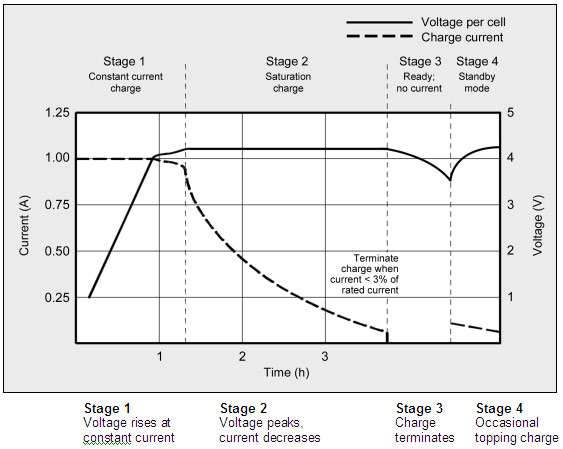
Not sure what the deal is as there are way too many variables when charging portable electronics. There are also a bunch of weird things including that 100% isn't necessarily a full charge on an iPhone. You could theoretically be using more than the power adapter can supply and it's actually tapping into the battery.
If you have a Mac and a tool called coconutBattery, it gets under the hood by tapping into a live reading of the battery health, giving the number of battery cycles recorded, and giving a (more or less) live reading of the charging current. For instance, if my iPhone is displaying 100% on the display, coconutBattery will show that it's fully charged and internally at 97% charge level. This is what I mean by 100% isn't necessarily a full charge. There are things that are done to reduce stress on the battery since constantly topping off a battery is not a good thing.
It's really difficult trying to explain all these things. There's a lot of math involved.