External Hard Disk and Ventura

Ever since I updated to Ventura my two hard disks shut down randomly with the error message "Disk not Ejected properly - Eject before disconnecting or turning it off".

I have checked cables, USB ports and all OK. It points to an issue with the OS (updated this morning to 13.0.1.

Please help as I cannot access my music.

iMac 21.5″, macOS 13.0

Posted on Nov 10, 2022 8:18 AM

Reply
Question marked as Top-ranking reply

Posted on Apr 16, 2023 3:50 AM

I just found a solution that worked for me on my 2018 Mini. I've been having a progressive issue with a WD 2TB SSD in a OWC Elite Pro Mini enclosure dismounting abruptly for probably over a year. In the last month, the drive wouldn't stay mounted for more than a couple minutes. The problem tracked with what I've read here. I tried swapping cables and enclosures. Neither worked (though as you'll see it was not a failing cable, but rather some sort of problem with communication over whole classes of cables). Yesterday, worried that the drive was failing, I ordered a new 2TB hard drive. I connected both to start transferring data over. The new drive started having the same dismount problem. I couldn't transfer more than 100gb. I tried running them off of an Anker dock. Still had the issue.


My solution: I tried my USB-A ports and the drive mounting completely stabilized. Then I realized I was using an Anker cable, and maybe it was the cable. I tried a USB-C 2.0 Anker cable through my Thunderbolt port. The drives were stable with that, too. I then tried an Apple Thunderbolt cable. Stable, plus return of 10gb/s transfer speeds. Cables that didn't work: a thunderbolt cable from 3rd party on Amazon, the USB-C 3.1 cable that came with my ProGrade SD card reader, and the USB-C 3.1 cable from OWC that came with my Elite Pro Mini enclosure. I recommend either using a high quality Thunderbolt cable, or a high quality USB 2.0 cable (if maintaining connection is more important than transfer speeds). Hope this helps someone!

64 replies
Question marked as Top-ranking reply

Apr 16, 2023 3:50 AM in response to LancasterHills

I just found a solution that worked for me on my 2018 Mini. I've been having a progressive issue with a WD 2TB SSD in a OWC Elite Pro Mini enclosure dismounting abruptly for probably over a year. In the last month, the drive wouldn't stay mounted for more than a couple minutes. The problem tracked with what I've read here. I tried swapping cables and enclosures. Neither worked (though as you'll see it was not a failing cable, but rather some sort of problem with communication over whole classes of cables). Yesterday, worried that the drive was failing, I ordered a new 2TB hard drive. I connected both to start transferring data over. The new drive started having the same dismount problem. I couldn't transfer more than 100gb. I tried running them off of an Anker dock. Still had the issue.


My solution: I tried my USB-A ports and the drive mounting completely stabilized. Then I realized I was using an Anker cable, and maybe it was the cable. I tried a USB-C 2.0 Anker cable through my Thunderbolt port. The drives were stable with that, too. I then tried an Apple Thunderbolt cable. Stable, plus return of 10gb/s transfer speeds. Cables that didn't work: a thunderbolt cable from 3rd party on Amazon, the USB-C 3.1 cable that came with my ProGrade SD card reader, and the USB-C 3.1 cable from OWC that came with my Elite Pro Mini enclosure. I recommend either using a high quality Thunderbolt cable, or a high quality USB 2.0 cable (if maintaining connection is more important than transfer speeds). Hope this helps someone!

Nov 12, 2022 2:24 PM in response to LancasterHills

Hello LancasterHills,


To help isolate the issue, see if the disks are slept after inactivity when "Put hard disks to sleep when possible" setting in System Settings is disabled. Check out how to access that setting here: Set sleep and wake settings for your Mac - Apple Support


"Specify sleep and wake settings for a Mac notebook computer

  1. On your Mac, choose Apple menu  > System Settings, then click Battery  in the sidebar. (You may need to scroll down.)
  2. Click Options on the right, then do any of the following: 
    • Put hard disks to sleep: Turn on “Put hard disks to sleep when possible.”
  • Update your system while it’s asleep: Click the pop-up menu next to Enable Power Nap, then choose an option.
    • See What is Power Nap?
    • Allow your Mac to wake briefly so users can access shared services (if applicable): Click the pop-up menu next to “Wake for network access,” then choose an option."


If unrelated to the above setting, then disconnect any peripherals apart from wired input devices or a single extra monitor to further isolate the behavior.


If the issue continues, test after using First Aid via Disk Utility on the disks to help check and repair any issues: Repair a storage device in Disk Utility on Mac - Apple Support


Let us know if that helps.


Kind regards.

Jan 25, 2023 9:55 AM in response to yeetng

No, it means that you have some 3rd party software that is interfering with the Finder's ability to see all attached drives.


Download and run Etrecheck.  Copy and paste the results into your reply. Etrecheck is a diagnostic tool that was developed by one of the most respected users here in the ASC and recommended by Apple Support  to provide a snapshot of the system and help identify the more obvious culprits that can adversely affect a Mac's performance.


Copy the report


and use the Additional Text button to paste the report in your reply.


Then we can evaluate the report to see if we can determine the cause of the problem.


May 2, 2023 4:51 PM in response to HonoraryGaucho

Read an earlier reply and it fixed it. The ports on the back of my external drives are USB B. The regular cords are USB B to USB A. For organizational reasons I used converters to go from USB A to USB C to plug into the C ports on the Mac Studio.


The fix for me was ditch the converters and plug into the USB A ports on the Mac Studio. No more sleeping or random ejecting. Could be hinky adapters, could be an oversight. I'm leaning towards adapters. We'll se if it continues to be remedied but I've been on the box 3 hours with 1 sleep cycle no issues.


Classic omission of useful data in my original post (the converters) and I apologize for that.

May 4, 2023 9:28 AM in response to LancasterHills

I have tried booting in safe mode.

I use the external drives on an older Mac running Big Sur—they work fine.

I tried plugging the drives in directly to all three ports on my ventura Mac—all failed.

I tested all 3 ports on ventura—all work fine.

I used the Ventura with an external drive with APFS and it worked fine.

I tried other things working with Mac support by phone. They told me that (unofficially) Ventura does not support Extended Journaled…and i have to change the hard drives.

I went to Genius Bar…and they tried various things—but told me from the begining that i will have to wait for a patch or upgrade my externals to APFS….(unofficially).

They said that MAC has not acknowledged the issue.

Some said that it is only an issue with 3.3.1.(a) —-3.3.1 works fine apparently… does anyone have a similar experience?


Oct 13, 2023 5:05 AM in response to LancasterHills

Having upgraded from Mojave to Ventura (2013 iMac with OpenCore Legacy Patcher) I found that external discs were not mounting, although they were identified in System Information. Unloading all startup items made no difference, the problem persisted with a fresh admin account, but when booting in safe mode the discs appeared. Eventually found that there was a USB conflict with my Wacom Blueberry tablet (it's from 2001 and EtraCheck was identifying the associated kernal as problematic). Disconnecting the tablet before or after startup enables the discs to appear. The tablet can then be plugged in for use and the discs remain mounted.

Nov 13, 2022 12:10 PM in response to LancasterHills

Thank you for trying those steps and keeping us posted on the issue, LancasterHills.


If the disks passed in First Aid, you'll want to manually eject and disconnect each drive. Once all drives are have been ejected and disconnected, connect only one drive, then click the Apple logo towards the top-left, followed by Restart in the menu. After the Mac restarts, log in to your user account to see if the issue persists.


If you continue to have issues, the next step is to create a new test admin user account, and log in to that user to see if the issue persists. You can find the steps for creating a new test user below and in the following article.


  1. "Click the New Account pop-up menu (you may be asked to enter your password), then choose a type of account.
  • Administrator: An administrator can add and manage other users, install apps, and change settings. The new user you create when you first set up your Mac is an administrator. Your Mac can have multiple administrators. You can create new ones, and convert standard users to administrators. Don’t set up automatic login for an administrator. If you do, someone could simply restart your Mac and gain access with administrator privileges. To keep your Mac secure, don’t share administrator names and passwords."

2.After creating the test user, click the Apple logo towards the top-left, followed by Sign Out in the menu.

3.Log in to the test user and see if the issue persists.


We look forward to the results!

Nov 15, 2022 8:28 AM in response to LancasterHills

LancasterHills,


Thanks for keeping us updated on this issue. We'd like you to try a few more isolating steps so we can narrow down what is going on.


Since the issue is still happening in your test user account, we'll want to see if it persists when in safe mode.


How to use safe mode

Determine whether you're using a Mac with Apple silicon, then follow the appropriate steps:

Apple silicon
1. Shut down your Mac.
2. Turn on your Mac and continue to press and hold the power button until you see the startup options window.
3. Select your startup disk, then press and hold the Shift key while clicking “Continue in Safe Mode.”
4. Log in to your Mac. You might be asked to log in again.

Intel processor
1. Turn on or restart your Mac, then immediately press and hold the Shift key as your Mac starts up.
2. Release the key when you see the login window, then log in to your Mac. 
3. You might be asked to log in again. On either the first or second login window, you should see ”Safe Boot” in the upper-right corner of the window.

Once in safe mode, you'll want to follow the steps under if the issue persists there or not. You can check those out here: How to use safe mode on your Mac - Apple Support


Then, tell us, how are your external drives connected to your iMac? Have you had a chance to test this issue out with another cable? If not, that can provide us a bit more details on which component is likely to be causing this issue.


Let us know how those steps go and we'll plan our next steps then.

Take care!

Nov 23, 2022 8:56 PM in response to MyndSurfers

Try this. I'll explain later why.


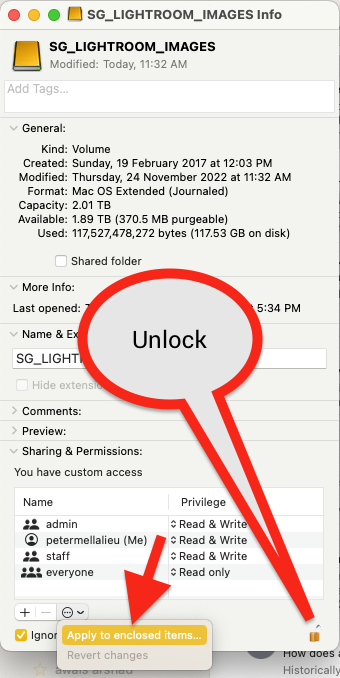
Adjust the permissions on the disk and all partitions, so that you (ie me) and admin have read-write access to the partition and all enclosed items.


Instructions....


Select the partition.

Use Finder/File/Get Info

(alternative Select then Command with I)


Investigate Sharing Permissions


Unlock the lock at bottom right.

Ensure you give Read and Write Privilege to:

admin

yourself (me)

staff [not sure if that's needed]

everyone [Read only] [not sure if that's needed]


Select also

Tick Ignore ownership of this volume


Select three dots ...

Select Apply to encolosed items.


Reason this permissions fix might work


I found my disk had a jumble of permissions.


Example, One partition would could not even be selected on another computer ... That got me suspicious.

Different partitions had different read/write access.

And I suspect the top level r/w access was NOT inherited by all files within the partition.


Good luck with this!


I suspect there's an issue with Ventura and/or my iMac2017

The disk problems I have are with Ventura on iMac2017, and with my previous OS, but not so frequently.


Proof

I connected my drive to an iMac 2010 with High Sierra.

I mounted and dismounted several times. No issues

I copied 50 GB from the disk to the iMac SSD. That took 50 to 70 minutes. No issues with the copy.


Thus, I suspect something 'strange with either Ventura and/or my iMac2017. Not a disk or cable issue.

Nov 22, 2022 3:06 PM in response to MyndSurfers

Further news.


I used Safe mode. It appears that I can both use the Seagate and LaCie drives without them causing issues.


I noticed my computer was behaving badly. For example, neither of my Bluetooth devices would work unless I wired them up through the USB-lightening charge cable.


I eventually realised that my SSD on the main iMac had just 40 GB of free storage, out of 500 GB total. So I cleared off some large files and moved an iMovie library elsewhere. Now I have 80 Gb of free space.


Now, back out of Safe Mode I find I can copy and move data from the Seagate to the LaCie drive. But the transfer rate appears slow. Eg copy takes 100 to 200 Mb/s whereas the drives are rated 5 GB/s (Seagate) and 50 Gb/s (La Cie. Why so slow?


Jan 25, 2023 1:34 PM in response to yeetng

First, there is no reason to ever install or run any 3rd party "cleaning", "optimizing", "speed-up", anti-virus, VPN or security apps on your Mac.  This documents describe what you need to know and do in order to protect your Mac: Effective defenses against malware and other threats - Apple Community and Recognize and avoid phishing messages, phony support calls, and other scams - Apple Support.  


There are no known viruses, i.e. self propagating, for Macs.  There are, however, adware and malware which require the user to install although unwittingly most of the time thru sneaky links, etc.   


Anti Virus developers try to group all types as viruses into their ad campaigns of fear.  They do a poor job of the detecting and isolating the adware and malware.  Since there are no viruses these apps use up a lot of system resources searching for what is non-existent and adversely affect system and app performance.


There is one app, Malwarebytes, which was developed by a long time contributor to these forums and a highly respected member of the computer security community, that is designed solely to seek out adware and known malware and remove it.  The free version is more than adequate for most users.  


That being said, you've installed and run what most of the experienced contributors to these forums consider akin to malware: CleanMyMac.


Uninstall CMM according to the developer's instructions. You can check to see if you've removed all of the supporting files by downloading and running the shareware app Find Any File to search for any files with the application's or the developer's name in the file name.  For CMM software you'd do the following search(es): 


1 - Name contains cleanmymac

2 - Names contains macpaw


Any files that are found can be dragged from the search results window to the Desktop or Trash bin in the Dock for deletion.


FAF can search areas that Spotlight can't like invisible folders, system folders and packages.  


This thread has been closed by the system or the community team. You may vote for any posts you find helpful, or search the Community for additional answers.

External Hard Disk and Ventura

Welcome to Apple Support Community
A forum where Apple customers help each other with their products. Get started with your Apple Account.