Have you noticed that Unicode Hexadecimal Input does not work if the UCS/Unicode four-digit hexadecimal code point number begins and ends with a zero, and what is done about it?

Some of you have probably noticed that Unicode Hexadecimal Input does not work if the UCS/Unicode four-digit hexadecimal code point number begins and ends with a zero. I have been in contact with Apple Support, and their tests have established that it is an error in macOS that started with Monterey 12.4, and has still not been resolved in Ventura 13.2.1.


Do you have suggestions how this can be fixed?

MacBook Pro 13″, macOS 13.2

Posted on Mar 9, 2023 5:21 PM

Reply
Question marked as Top-ranking reply

Posted on Mar 10, 2023 6:47 AM

JAGSiH wrote:

Some of you have probably noticed that Unicode Hexadecimal Input does not work if the UCS/Unicode four-digit hexadecimal code point number begins and ends with a zero.

Until pretty recently, I never knew that such an option exists. For many years, I made fun of Windows users because they were forced to use a similar method for any text that wasn't plain ASCII.

Do you have suggestions how this can be fixed?

Fixing is a tall order. This is a user-to-user support forum for Apple products. There is absolutely nothing we can do to "fix" any Apple bugs. All we can provide is insight and workarounds.


For insight, I suggest finding a workaround. This input option is an old-school, Mac, and keyboard-based input method. It won't work on iOS or a phone, so that means that you really shouldn't expect it to work on a modern Mac either. Anything that is Mac-specific has to be really, really, really important before Apple will make any change. Clearly this bug has not meet that criteria.


Instead, the workaround I recommend is to use the "Emoji and symbols" display, also known as "Character viewer".
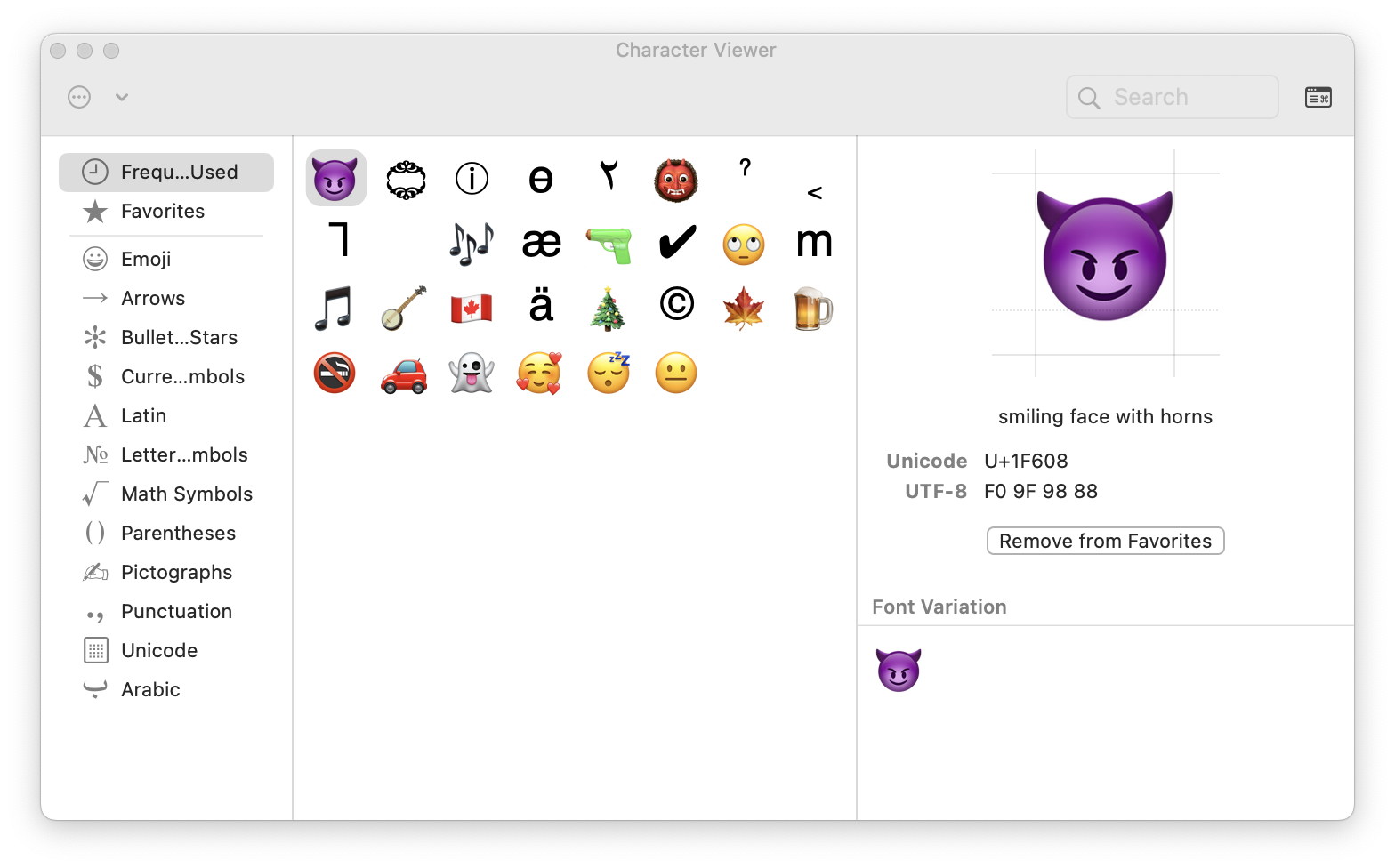

This display has categories for both frequently used symbols and favourites. If there are specific characters you want to have available, add them to the favourites list.


The Character viewer has its own set of bugs and annoyances. My biggest complaint is that it is app-specific. If you open the character viewer for Safari, then it will not appear in a different app. You will have to open a different character viewer for the other app. And sometimes apps or web sites don't work with the character viewer. This site in particular doesn't. I need to remember to complain about that.


40 replies

Mar 12, 2023 11:30 AM in response to Tom Gewecke

Thanks. I imported your .plist file.


In TextEdit I get it to work. But I had to press the space bar (or write a HYPEN‐MINUS U+002D), which means I get a SPACE (or HYPHEN‐MINUS) after. Same thing happens in this window where I write this reply. If i write 00B0x many times (I added an x to stop the substitution) I have to press the space bar, which means I have to insert spaces like this: ° ° ° . If I want to write °°°, I have to delete the space every time. I never want to write °°°, but I’m demonstrating that there is an extra key to press (the Delete key) every time I have written one of these 0xx0 characters. But your suggested method is still very good.


However, I could not make it work in Microsoft Word for Mac.

Mar 12, 2023 7:12 PM in response to Tom Gewecke

You are, as an unpaid volunteer, providing the support Apple Inc. and Apple Support are unwilling and unable to provide. Thank you.


Tom Gewecke wrote:

MS Word has its own list of substitutions

Yes, I knew that, but it was very late in Canberra (early morning) and I didn’t try. Now when I do this I have found a problem. I have made the rule that 0 2D0 should become ː MODIFIER LETTER TRIANGULAR COLON (I inserted a space in 0 2D0 between the zero and the 2 to stop the rule from being implemented as I type here). The problem is that there needs to be a space before 02D 0 (I did same trick with space). If i want to write a word in phonetic transcription, like this: [eːr], I must first write [e ː and then go back and change to [eː and then finish it so I get [eːr].

To avoid the extra space try pressing down arrow and return instead.

That didn’t work when I tried.

This thread has been closed by the system or the community team. You may vote for any posts you find helpful, or search the Community for additional answers.

Have you noticed that Unicode Hexadecimal Input does not work if the UCS/Unicode four-digit hexadecimal code point number begins and ends with a zero, and what is done about it?

Welcome to Apple Support Community
A forum where Apple customers help each other with their products. Get started with your Apple Account.