NAS Access in Catalina issues

Since upgrading to Catalina my access to NAS shares is problematic.


I have a QNAP NAS unit, with APFS and SMB (1/2/3) enabled.


I can see the NAS in finder under 'Locations' but when I click on the NAS I get 'connection failed'. Using 'Connect As' does nothing at all.


I manage to connect using 'Connect to server' with the command: afp://NASNAME(AFP)._afpovertcp._tcp.local


It asks me which 'share' I want to connect and all works well.


If I then go back through finder to the same share I get the same 'connection failed' issue, even though the mounted share shows on my Desktop.


Any ideas please?

Mac mini 2018 or later

Posted on Oct 28, 2019 4:06 AM

Reply
Question marked as Top-ranking reply

Posted on Feb 5, 2020 11:53 PM

I was having this problem with Catalina and my Synology, and this article solved it for me.

https://www.techarp.com/software/macos-catalina-nas-failure/

The Cause Of The macOS Catalina NAS Connection Failure

From what we can tell, this issue is happening because Apple apparently dropped support for SMB1 and SMB 2.0 in macOS Catalina. With many NAS defaulting to SMB1 for compatibility reasons, users will immediately lose the ability to connect once they upgrade to macOS Catalina.


The Fix:

  1. Log into your NAS
  2. Go to Control Panel > File Services.
  3. Under the SMB section, click on Advanced Settings.
  4. In the Advanced Settings pop-up, you will find that the Maximum SMB protocol is probably set to SMB1.
  5. You need to set the Maximum SMB protocol to SMB3.
  6. Now, this is not necessary, but while you are here, you might as well just set the Minimum SMB protocol to SMB2 and Large MTU.
  7. Then click Apply at the bottom of the Advanced Settings pop-up to save the settings.


I did it and my Synology NAS access from Catalina has been rock solid for the last 48 hours!!!!


Similar questions

312 replies
Question marked as Top-ranking reply

Feb 5, 2020 11:53 PM in response to stoobloo

I was having this problem with Catalina and my Synology, and this article solved it for me.

https://www.techarp.com/software/macos-catalina-nas-failure/

The Cause Of The macOS Catalina NAS Connection Failure

From what we can tell, this issue is happening because Apple apparently dropped support for SMB1 and SMB 2.0 in macOS Catalina. With many NAS defaulting to SMB1 for compatibility reasons, users will immediately lose the ability to connect once they upgrade to macOS Catalina.


The Fix:

  1. Log into your NAS
  2. Go to Control Panel > File Services.
  3. Under the SMB section, click on Advanced Settings.
  4. In the Advanced Settings pop-up, you will find that the Maximum SMB protocol is probably set to SMB1.
  5. You need to set the Maximum SMB protocol to SMB3.
  6. Now, this is not necessary, but while you are here, you might as well just set the Minimum SMB protocol to SMB2 and Large MTU.
  7. Then click Apply at the bottom of the Advanced Settings pop-up to save the settings.


I did it and my Synology NAS access from Catalina has been rock solid for the last 48 hours!!!!


Mar 30, 2020 1:10 AM in response to Datajack

Of course, my setup is:

  • iMac (Retina 5K, 27-inch, Late 2015) connected via ethernet through GS108 then to the GS116Ev2 then into the NAS boxes
  • 2 x QNAP TS-453Be
  • 1 x QNAP TS-451+
  • Microtik router as supplied by my broadband provider (pretty standard out of the box config)
  • GS116Ev2 - 16-Port Gigabit Ethernet Smart Managed Plus Switch
  • GS108 - Netgear Prosafe Gigabit 8 port smart switch


All NAS boxes are set to use SMB 2.1 & SMB 3 only!! I would never want to go as far back as SMB 1 due to the speed being so poor.


I did have these drives set to auto connect when I login to the machine as a login item under my user profile.


So what I did was as follows:

  1. Logged into the QNAP admin dashboard and ensured all drives where set to be using SMB 2.1 or SMB 3 and not SMB 1
  2. Disconnected from all drives
  3. Removed all drives from my login items
  4. Removed drive shortcuts from the Finder sidebar
  5. Removed all credentials to these drives from Keychain Access
  6. Ran sudo dscacheutil -flushcache; sudo killall -HUP mDNSResponder
  7. Restarted the machine and reconnected to the drives in Finder using credentials on the drives which have administrator access
  8. Added drives back to my login items


Since doing all this I have had no issues with connections to the drives other than at startup when I get a message during the loading of login items where OS says it cannot connect to the drive, I simply hit okay and it seemingly connects after that anyway. These mounts stay on the machine without any issues and remain connected without dropouts since I did all of this.


It appears as though you need to remove all traces of the drives and connections from your machine to then go back in and add them fresh again. Still doesn't explain why I had no issues on my Macbook Pro though which also runs Catalina...

May 21, 2020 12:50 AM in response to roken70

@roken70


Wanted to share my workaround for this annoyance I have successfully been using for the last few weeks:

Create Shell Script

I have written the attached shell script "mountshares" to mount my shares. Replace placeholders <> with your server and share names. SHARES is an array, so you can adjust the number of space-separated entries to your need. Note also the NAS user name, which in my case is the same as my Mac login user name.

Store the script in your home directory. I have added the folder "bin" there. So the script has the path:

/Users/<your-user-name/bin/mountshares

Make the script executable and secure access (open Terminal and enter run this command):

chmod 700 ~/bin
chmod 700 ~/bin/mountshares

Now, when you run this script (you may run it from Finder too). All your shares are mounted under /Volumes, which is the standard location.

Store passwords in KeyChain

I store my sudo password (which is your login password) and the server password in Keychain access.

Create a new entry in Keychain access with the name mountshares and one for the server with the name of the server (SERVER.local). The last one is normally created by Finder too, so you may have it already in your KeyChain.

When you run the script, it will ask for permission to access your Keychain like any normal app. You may give permanent permission to the script, if you wish.

Run script at login - Create Login Item

I wrap the script in an Automator Application like this (Note unchecked check box "Show this action ...").

Add the Automator Application to your Login Items ( > System Preferences > Users & Groups > your user > Login Items
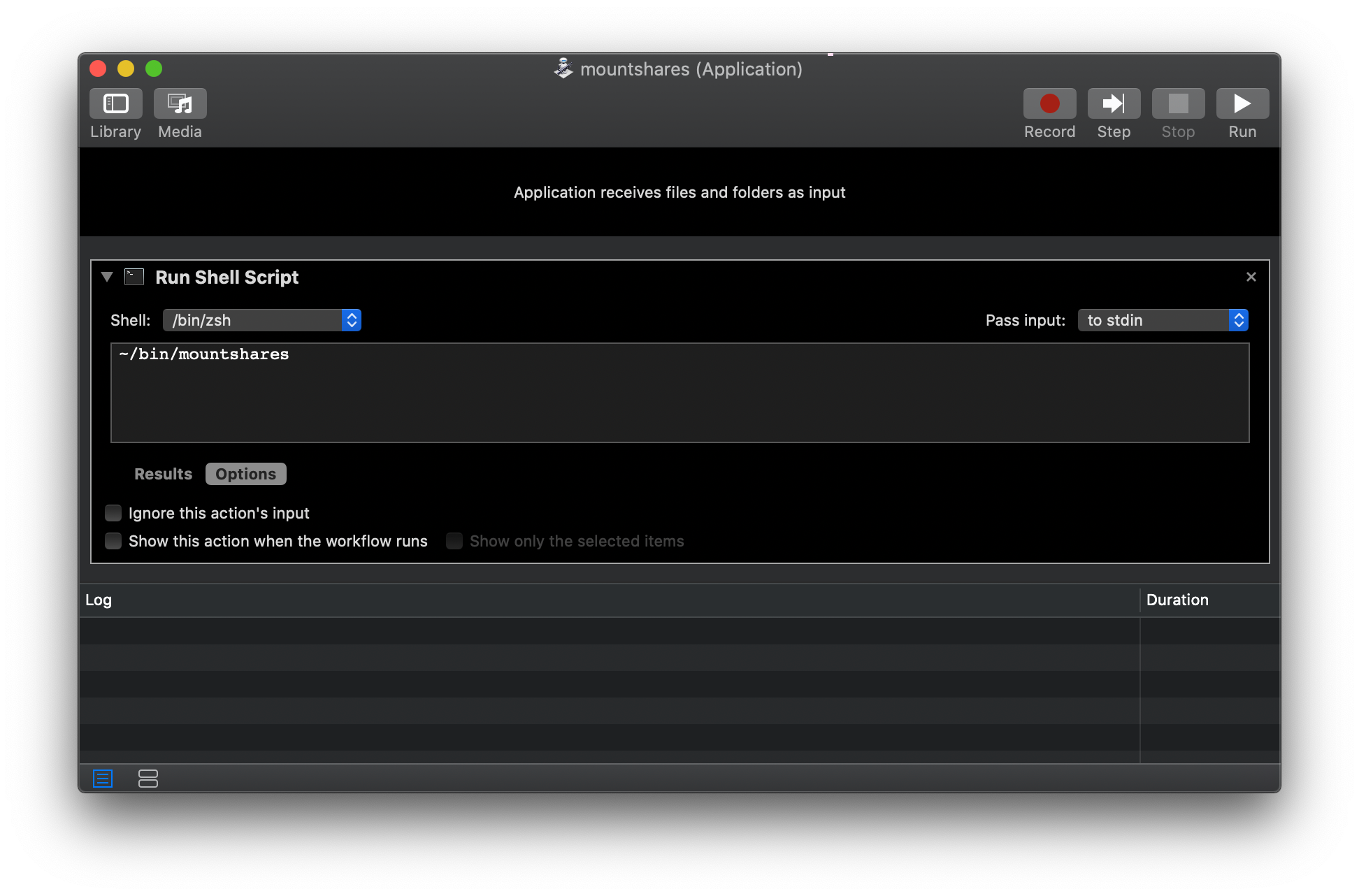
From the next time log in again (i.e. you have to log out properly, not just lock the screen), your shares will be automatically mounted.

Finder adjustments

I have added /Volumes to my Finder sidebar. In Finder:

Press Cmd-Shift-G and enter "/Volumes". Press return.
Press Cmd-Ctrl-T to add the Volumes-folder to the sidebar.

Now you can access your shares through the sidebar item Volumes without Finder failing. In case the mounts are gone (can happen, because of whatever Finder reasons), you re-run the script or - better - Automator application and the mounts appear again.

If you have any suggestions for improving the script (securing and fail-proving), please do not hesitate to share.

My goodness, need to be an IT Tech to be able to solve such a problem of using a NAS on Catalina...


Jul 9, 2020 12:49 AM in response to stoobloo

New to this party.

I am also strugling with folders on my Synology NAS en Time Machine backups to both NAS and USB drives on Catalina 10.15.5. Before 10.15.5 everything was working fine, from iMac 2017.


From various reports it seems that Apple has strengthened network security in Catalina, for instance disabling Netbios and SMB v1. This may wel explain the experiences we now have.


There is mention of a fix (or workaround) on the site Reduser.net by Bob Zelin (thanks a lot, Bob; by the way this site has more valuable knowledge and insights):


"This is how to resolve the Catalina "disconnecting" issue from NAS systems. This has nothing to do with QNAP, or Synology or any other brand. This is an Apple issue, and this is the fix. 

This fix was written by Apple, but it is "hidden" and their own tech support doesn't seem to know it. (crazy - right ?). 

this is as of 5/21/2020. I have verified that this works with multiple clients for the past 30 days. 


On the Mac running macOS 10.15 - open terminal and type this in

nvram boot-args

you will get an error message

now, copy and paste the line below, and put this into terminal, and hit return - it will ask for your password - you will not see anything when you type in your password


sudo nvram boot-args="serverperfmode=1 $(nvram boot-args 2>/dev/null | cut -f 2-)"


now, once again, type in nvram boot-args

you will now see this - 

boot-args. serverprefmode=1


reboot your Mac. 

You will no longer get disconnects


Bob Zelin"


I have tried this fix an it made my Synology NAS operational again. Time machine on the NAS is working again. Albeit that my TM backup history was completely lost, because of restart of the TM trail. It may help others as well.


The lack of communication on the applied network security changes in 10.15.5 by Apple is a bit disappointing to me. I use this iMac professionally and the experienced loss of productivity en subsequent trouble shooting has taken quite some time. A little more communication and support would have been appreciated.


Hope this helps.

Feb 9, 2020 3:09 AM in response to SgtTed83

SPOILER ALERT: this is not a solution but a "working" WORKAROUND


My actual situation:

  • I'm able to access to my NAS (SMB shares) through finder left sidebar only after a reboot
  • I'm Always able to connect to my SMB shares by "command K"
  • my NAS implements SMB v3_2 protocol


My workaround (tested working after several working time or sleep):

  • reboot the mac
  • connect to NAS through sidebar network shortcut. This will mount shares on the desktop
  • drag the shares icons on your desktop on finder sidebar but in "favorite" section (as in attached picture)


Now, every time you need to access these shares use these links on favorite sections instead of the one in network.

This definitely demonstrates that is not a "protocol connection issue" but a Finder specific issue.


May 19, 2020 3:17 AM in response to ArturRuz

Wanted to share my workaround for this annoyance I have successfully been using for the last few weeks:


Create Shell Script


I have written the attached shell script "mountshares" to mount my shares. Replace placeholders <> with your server and share names. SHARES is an array, so you can adjust the number of space-separated entries to your need. Note also the NAS user name, which in my case is the same as my Mac login user name.


Store the script in your home directory. I have added the folder "bin" there. So the script has the path:


/Users/<your-user-name/bin/mountshares


Make the script executable and secure access (open Terminal and enter run this command):


chmod 700 ~/bin
chmod 700 ~/bin/mountshares


Now, when you run this script (you may run it from Finder too). All your shares are mounted under /Volumes, which is the standard location.


Store passwords in KeyChain


I store my sudo password (which is your login password) and the server password in Keychain access.


Create a new entry in Keychain access with the name mountshares and one for the server with the name of the server (SERVER.local). The last one is normally created by Finder too, so you may have it already in your KeyChain.


When you run the script, it will ask for permission to access your Keychain like any normal app. You may give permanent permission to the script, if you wish.


Run script at login - Create Login Item


I wrap the script in an Automator Application like this (Note unchecked check box "Show this action ...").


Add the Automator Application to your Login Items ( > System Preferences > Users & Groups > your user > Login Items

From the next time log in again (i.e. you have to log out properly, not just lock the screen), your shares will be automatically mounted.


Finder adjustments


I have added /Volumes to my Finder sidebar. In Finder:


  1. Press Cmd-Shift-G and enter "/Volumes". Press return.
  2. Press Cmd-Ctrl-T to add the Volumes-folder to the sidebar.


Now you can access your shares through the sidebar item Volumes without Finder failing. In case the mounts are gone (can happen, because of whatever Finder reasons), you re-run the script or - better - Automator application and the mounts appear again.


If you have any suggestions for improving the script (securing and fail-proving), please do not hesitate to share.

Jul 6, 2020 2:21 PM in response to stoobloo

I got myself fed up with this issue - I use a Synology NAS.

Restarting the Finder works but you loose all your Finder window with tabs, bummer when you just get prepared to make a file copy.


Other that the Finder restart, I didn't find any workaround that worked for me, except one involving autofs - which comes with macOS.


I decide to write down the few steps that got me working here:

hhttps://gist.github.com/bitonio/b1248a4aa1e137bae7d857effeaddcda


Give it a shot if you've exhausted all other options.

Jul 12, 2020 6:05 AM in response to Martin Deisting

@Martin Deisting


I tried what Bob Zelin proposed:


Martin Deisting wrote:

"This is how to resolve the Catalina "disconnecting" issue from NAS systems. This has nothing to do with QNAP, or Synology or any other brand. This is an Apple issue, and this is the fix. 
This fix was written by Apple, but it is "hidden" and their own tech support doesn't seem to know it. (crazy - right ?). 
this is as of 5/21/2020. I have verified that this works with multiple clients for the past 30 days. 

On the Mac running macOS 10.15 - open terminal and type this in
nvram boot-args
you will get an error message
now, copy and paste the line below, and put this into terminal, and hit return - it will ask for your password - you will not see anything when you type in your password

sudo nvram boot-args="serverperfmode=1 $(nvram boot-args 2>/dev/null | cut -f 2-)"

now, once again, type in nvram boot-args
you will now see this - 
boot-args. serverprefmode=1

reboot your Mac. 
You will no longer get disconnects

Bob Zelin"


I will see if it solves the problem, since from the beginning I am affected, Cemento's workaround does not solve the problem of Time Machine which fails in my case :-(((

I do hope it works, I will report in few weeks.


@ Martin, once you applied the fix, how do you connect to your NAS ? Using the IP address or the name ?


Thanks,

Fly_PetitPrince

Jan 7, 2020 2:20 PM in response to stoobloo

I was having the same problem (plus the additional one of my photos volume mounting randomly on its own) and was getting the runaround. Synology support said because the issue is fixed with restarting finder, the issue lies with Apple. However, Apple was telling me they don't support third party anything. At first I tried a full reinstall of the OS (after the latest patch), but had no luck. In the end, I fixed the issue by creating a new admin user. It seems the installation of Catalina somehow created some issues within the user preferences. I manually migrated all my files/folders over, including select preferences files, which only ended up being a small hassle - but much less time than I collectively spent with the different tech supports. Now, problem solved! Hope this solution might work for some of you as well. 

Jan 21, 2020 9:06 PM in response to bsanders44

hey bsanders44,


To begin with, I had some the same problems you're having.  However, since 10.15.2, my network connection to my NAS and Time Machine have not missed a beat.  OK, the set-up looks different now, but it's reliable.


So, maybe, you've got a few gremlins... turned-sideways.  And, both the ox and the cart are in the ditch.  Here's a procedure that just may set things to rights.


First, let's see if we can perform a few house-cleaning chores and lose the NAS from macOS recent memory: 

  1. Disconnect your NAS from the network but leave the power on.
  2. At "Go>>Connect to Server", remove any previous server-path listed there.  Also, be sure to use the "gear" (settings) icon to "clear recent servers".
  3. At Time Machine app>>Select Disk, highlight the current disk and remove.
  4. Shut-down you Mac completely.
  5. Perform the SMC reset: unplug the machine from power for 15 seconds, plug the machine back in, wait 5 seconds, then hit the start button.
  6. After the machine has booted and you're logged in, check Finder to see if your NAS appears in the side-bar under Network.
  7. Even if the NAS is no longer listed, perform one more re-start your Mac.
  8. Perform another check in Finder to make sure your NAS is no longer listed in the side-bar under Network.  
  9. Once you are sure it is gone, shut-down your Mac.


This ends the house-cleaning part of this resolution.


At this point, perform the following to restore the NAS connection:

  1. Connect your NAS back to the network.  
  2. Once the NAS indicates it has a "network connection", power-up your Mac and allow it to boot, and log-in.
  3. Go to Finder, open Network and allow at least 5 minutes for any or all of your network devices to check-in (appear).
  4. At this point, you may see the NAS unit's device name appear in the Network folder and subsequently as a "stand-alone" entry in the Sidebar.  Yes, macOS discovered my NAS on it's own!  And, I no longer have to use the NAS IP address for Time Machine!)
  5. Using the stand-alone entry, you may see your NAS device name waiting to "connect as:" the primary user name of you drive. (In my situation it did.  However, I change it to the "user" name I had previously setup for my "TimeMachineBackup" share.)
  6. Do not use "Go>Connect to Server"!
  7. Do look for the "eject icons" at each folder level in Finder.  To me, this indicates a successful, stable device connection that will survive a "re-boot". 


Give the above a try and see what happens.  It shocked the crap out of me after I saw it fix mine.


Good luck!  Let me know if anything happens.


Best regards,


OM2

Feb 28, 2020 6:27 PM in response to stoobloo

I had to come here share my own findings. Can't say for sure, but seems like a problem only in Finder. Killing Finder and restarting fixes it at least temporarily. Problem happened immediately after upgrade to Catalina from Mojave.


*** Issue description**** Had the same problem. Can't always access my QNAP NAS from finder by clicking on the NAS name for the SMB connection (MyNAS). Sometimes clicking on "connect as" doesn't do anything, and other times it will show the root folders but clicking on any will say directory does not exist. If in Finder I click on the AFP connection to my NAS (MyNAS (AFP)), works fine. IP address also works. My NAS is set to run only SMB 2 & 3.


*** Non-finder connections work**** Strange thing, my TimeMachine backups, pointing to MyNAS(TimeMachine) work fine. It is using SMB and the NAS name (not IP). I have other automated backups running in the background also using SMB, seems to work most of the time—I have some backup issues in another software but not sure if related.


It really seems like it's a Finder issue.


**** Killed finder, works***** Here's something I tried and worked. I killed Finder (Force quit > Finder > Restart), when to my NAS in Finder (the SMB one), and was able to browse the content just fine.


I'm hoping Apple will fix this. I don't want to connect using AFP and don't want to connect using IP. I just want everything to work as intended and as it did before I upgraded to Catalina.

Jun 2, 2020 10:54 AM in response to stoobloo

I also had problems with MacOS and a Synology Diskstation for quite some time now. I kept restarting Finder but since my daughter lost parts of her homework because the network share did not reconnect I got tired of this workaround and tried to fix the issue.


As it was already mentioned the major problem seems to be name resolution. At the moment I am testing two "fixes" which have proven to work at least for a day.


1) Using hosts file for overriding name resolution: I added entries for my diskstation in the hosts file (/etc/hosts) on my mac.

192.168.1.10    diskstation
192.168.1.10    diskstation.local
192.168.1.10    diskstation._smb._tcp.local

Maybe only the last line is really important (The IP address and the name has to be changed to the actual address and name).


2) Addressing the share by it's local domain: In my network the dns is provided by a router running OpenWRT. The Local domain is configured to be "lan" by default (corresponding to option domain 'lan' in /etc/config/dhcp on OpenWRT).


I started using both methods some hours ago and have not lost the connection to my NAS yet even though I repeatedly let MacOS go to sleep.

Jun 6, 2020 2:15 PM in response to bsanders44

Update: I've been using Cemento's approach (https://discussions.apple.com/thread/250794335?answerId=252112800022#252112800022) of dragging the networked drive(s) to the desktop and then back to the sidebar under Favorites since June 4 (2 days ago). After some period of time, the networked drives disappear from my desktop. Each time when this has occurred, clicking on the new links under Favorites in Finder's sidebar has immediately remounted the shares, with the icons appearing again on the desktop. I am then able to browse the shares without any issues. Since implementing this approach, I have not had any popups or errors indicating a failed connection, so that seems to be a major improvement.


I'll continue to update over the coming weeks...

Jun 8, 2020 2:42 AM in response to bsanders44

@bsanders44, @bruno_l, @Cemento, @Datajack,


Thanks for the additional hint. I hadn't used <Go><Connect> in Catalina for a while. Now I did and can confirm that this caused severe performance issues in accessing NAS files.


Accessing files on my shared folder via <Go><Connect> took ca. 12 minutes, what used to be a few seconds. Even calculating the size of the shared folder by clicking on <Get Info> took that long.


And when trying to access my NAS via <Locations>, the connection to the NAS was established and I could see my shared Folders, but I could not access them! See screenshots attached.


On the positive side, when dragging shared folders icons from the Desktop as you described, the performance was good as it used to be. Too early to draw final conclusions, but the connection was stable so far, even after Sleep periods and after rebooting the MacBook and/or the NAS server.


FYI: The reason that I had difficulties to find the shared folder icons on the desktop in the first instance was that I seem to have too many screenshots on my desktop and the shared folder icons were heaping up in the upper right hand corner of my desktop, mingled together with multiple icons for files. Very difficult to spot as shared folder icons. Now I have created a dedicated folder for screenshots, so they don't mess up my desktop anymore. 


So, we seem to have at least two workarounds for the time being as far as I tested:

1) Dragging the Shared Folder icons from the Desktop to Favourites

2) Modifying the 'hosts' file as described by @bruno_l as his 'method one'.


There may be other workarounds as well, which is a good thing, but definitely not a solution for the average user who just wants to have a trouble-free MAC OS system.


The action is now with Apple to learn from this thread and implement a reliable solution for Finder as soon as possible.

Jun 11, 2020 10:39 AM in response to bsanders44

Update: I've been using Cemento's approach (https://discussions.apple.com/thread/250794335?answerId=252112800022#252112800022) of dragging the networked drive(s) to the desktop and then back to the sidebar under Favorites since June 4 (one week ago). Overall it still seems to be a viable workaround/mitigation approach, although it isn't perfect.


In the past week, I've had the disconnect popup/dialog appear twice. Both times, I've clicked "Ignore". I've also had the icons on my desktop disappear several times, but clicking on the new links under Favorites in the sidebar has brought them back. On the most recent occasion, the new links displayed question marks when clicked, but after several seconds reestablished the connection. On a previous occasion, Finder displayed the spinning icon for several minutes, while it (apparently) tried to reestablish the connection, and eventually succeeded in displaying the contents of the remote drives.


So, there have been some hiccups, but on the upside, my machine has remained stable, Finder has not crashed or become completely unresponsive, and I've been able to reconnect to the NAS in Finder, typically within a few seconds, by clicking on the new links. I've also not had to restart my machine even once. This is a DRAMATIC improvement over what was happening before. So, at least for now, it appears that Cemento's workaround is viable for me. YMMV, and so it would be helpful if other users here can confirm that this approach is still working for them.


I'll continue to update as more time passes....

This thread has been closed by the system or the community team. You may vote for any posts you find helpful, or search the Community for additional answers.

NAS Access in Catalina issues

Welcome to Apple Support Community
A forum where Apple customers help each other with their products. Get started with your Apple Account.